August 6, 2026
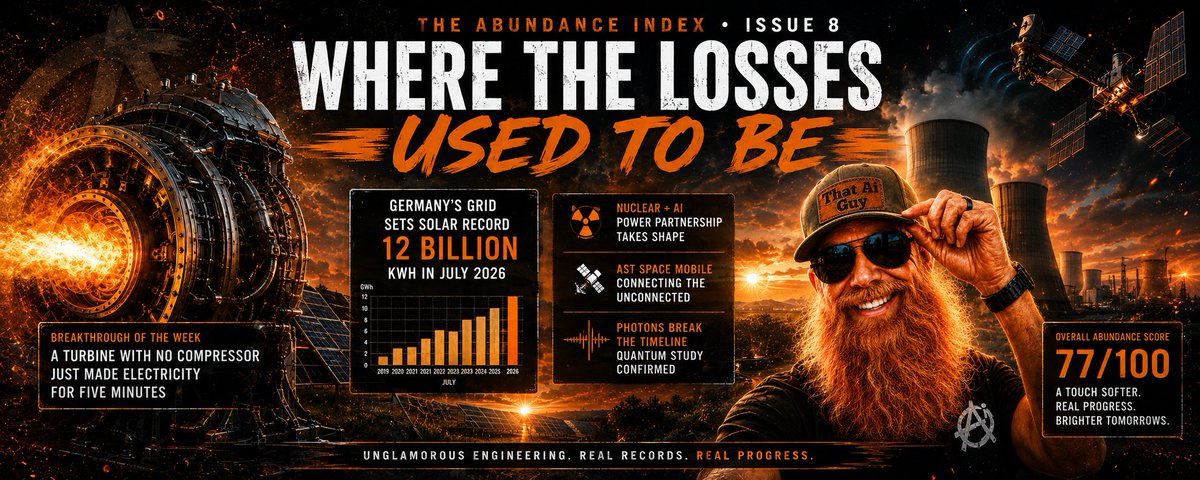
Overall Abundance Score: 77/100
Status: A touch softer than last week’s 79. Nothing this week carries the multi-year field data that drove Issue 7’s score. Instead it’s a lab record, a signed agreement, and a beta rollout. Each real, each still early.
Executive Summary
This week’s clearest story came out of a lab in Karlsruhe, Germany, where engineers ran a hydrogen turbine with no mechanical compressor for 303 seconds, generating electricity the entire time. That is a genuine world record, and it targets a real problem: conventional turbines burn away roughly half their output just compressing air before combustion even starts. Removing that step does not change anyone’s electricity bill this year, but it is the kind of unglamorous engineering gain that eventually does.
The rest of the week filled in around that story with more infrastructure than invention. Germany’s grid absorbed a record 12 billion kilowatt-hours of solar power in a single month. A U.S. utility, a reactor manufacturer, and a construction firm signed a preliminary agreement to evaluate small nuclear reactors for the Gulf South’s growing data-center demand. AST SpaceMobile launched three more satellites toward a constellation that is real hardware in orbit, even if the service it promises is still intermittent. And physicists confirmed, more rigorously than before, that a photon really can exit a cloud of atoms before it seems to have entered it.
None of this is finished, and some of it may not go anywhere. The turbine ran for five minutes, not five months. The nuclear agreement is non-binding and names no site. AST SpaceMobile has 13 of the roughly 45 satellites it needs for continuous coverage, and lost one satellite to a launch failure earlier this year. The quantum result has no application yet and may never get one outside a physics classroom.
Most weeks this newsletter finds one clean win. This week it found several small ones, none finished, all real.
Breakthrough of the Week
A turbine with no compressor just made electricity for five minutes
What happened: Researchers at the Karlsruhe Institute of Technology (KIT) operated a hydrogen gas turbine that generates its own combustion pressure through detonation waves, rather than a mechanical compressor, for a record 303 seconds (surpassing NASA’s previous 250-second mark) while converting the combustion directly into electricity for the first time.
Why it matters: A conventional gas turbine spends about half its power output compressing air before it can burn fuel efficiently. A turbine that generates its own pressure through the combustion process itself skips that step entirely, which is a structural efficiency gain rather than an incremental one.
What friction it removes: Pressure-gain combustion has been a laboratory curiosity for decades because the reaction was too violent to sustain. Earlier attempts melted their combustion chambers in fractions of a second. This test ran more than five minutes and produced usable electricity throughout.
What to keep sober: Five minutes is not a duty cycle a power plant can sell electricity on. This is one lab-scale unit, tested once, with no announced timeline for a commercial turbine, and pressure-gain combustion research has a long history of taking decades to reach real hardware.
The abundance signal: This is a verified world-first, not a press release about potential. Removing a compressor is exactly the kind of unglamorous fix that eventually shows up in a lower electricity bill or a lighter aircraft engine.
Source: ScienceDaily, August 4, 2026
Major Developments
1. Germany’s grid takes in more sun than ever before
Germany’s photovoltaic systems fed 12 billion kilowatt-hours of solar electricity into the public grid in July 2026, the first time any single month has cleared that mark, according to an analysis of European grid data by the IWR research group. Average midday solar output topped 40,000 megawatts, equivalent to the output of more than 40 large nuclear plants, displacing a meaningful share of coal- and gas-fired generation during daylight hours.
Why it matters: This is not a forecast or a target. It is what the grid actually carried last month, in a country that has spent two decades building out rooftop and utility-scale solar.
What to keep sober: The IWR is an industry-aligned research group, not an independent statistics office, and the figure excludes solar power consumed on-site rather than fed to the grid, which means the true generation total is higher but harder to verify. Germany’s system also still carries higher-cost legacy feed-in tariffs from panels installed between 2010 and 2013, which run through 2033 regardless of this month’s output.
The abundance signal: A record that already happened, made of electricity that already displaced fossil generation, is worth more than a projection of one that might.
Source: SolarQuarter, August 3, 2026
2. Nuclear gets a seat at the AI power table
Holtec International, Entergy, and Hyundai Engineering & Construction signed a non-binding agreement on August 4 to evaluate building dual-unit SMR-300 small modular reactors across Entergy’s Gulf South territory, spanning Louisiana, Mississippi, Texas, and Arkansas, to supply carbon-free baseload power for data centers and industrial growth. A standard dual-unit installation would deliver about 680 megawatts, in the range of a mid-sized coal plant, without the smokestack.
Why it matters: It is a concrete sign that utilities are responding to AI-driven electricity demand with new nuclear capacity rather than defaulting to gas peaker plants, which is the more familiar and faster, but dirtier, answer.
What to keep sober: This is an agreement to study the idea, not to build it, and it names no site and no construction date. Holtec’s SMR-300 design has not generated power anywhere yet; its first reference units, at the Palisades site in Michigan, are still under development.
The abundance signal: Utilities do not sign these agreements idly. It is an early but real data point that advanced nuclear is being treated as a practical option for near-term demand, not a distant one.
Source: GlobeNewswire, August 4, 2026
3. Satellites start closing the coverage gap, slowly
AST SpaceMobile launched three more Block 2 BlueBird satellites on August 5, bringing its constellation to 13 operational spacecraft, each carrying a phased-array antenna roughly the size of a basketball court, large enough to connect directly with an ordinary, unmodified smartphone from low Earth orbit. The satellites also earned a Guinness World Records title for the largest commercial communications arrays ever placed in orbit.
Why it matters: This is real infrastructure aimed at rural, coastal, and disaster-affected areas where a cell tower will never reach, using phones people already own rather than new hardware.
What to keep sober: Continuous coverage requires roughly 45 satellites. At 13, the beta service expected later this year will be intermittent, with gaps between satellite passes measured in hours rather than minutes in underserved areas, and the company already lost one satellite to a launch anomaly earlier in 2026. AST also pushed its 45-satellite target from the end of 2026 to early 2027.
The abundance signal: Hardware already in orbit, expanding on a known schedule, is a stronger signal than another funding round or another announcement of intent.
Source: Tech Times, August 5, 2026
4. Basic science: a photon that leaves before it arrives
Physicists at the University of Toronto and Griffith University published a peer-reviewed confirmation that photons passing through a cloud of rubidium atoms show a negative dwell time, appearing to exit the cloud, on average, before they entered it. The effect was first glimpsed in a 1993 experiment, but this time the researchers verified it two independent ways at once: from the light’s arrival time, and from a direct, deliberately imprecise measurement of the atoms themselves.
Why it matters: It confirms that one of quantum mechanics’ strangest predictions is not a measurement artifact but a physically real, repeatable effect, which matters for future work in quantum sensing and light-matter interaction.
What to keep sober: This does not enable time travel or faster-than-light signaling, and the researchers are explicit about that. There is no proposed application today, and there may not be one for years, if ever.
The abundance signal: Most weeks, the science section of this newsletter is exactly this: nothing you can buy, nothing you can use yet, and the raw material future usefulness sometimes comes from.
Source: ScienceDaily, August 4, 2026
Why This Matters
The connecting thread this week is not a new technology. It is systems already built or already launched being made to do more with what they have: a turbine losing less energy to its own compressor, a grid absorbing more of the sun already falling on it, a satellite fleet squeezing more coverage out of the hardware already in orbit, and a decades-old quantum effect finally pinned down with a second, independent measurement.
Each of these still depends on follow-through that has not happened yet. The turbine needs to survive test runs measured in hours, not minutes, and then find a manufacturer willing to build one. The nuclear agreement needs site selection, financing, and Nuclear Regulatory Commission licensing to all go the right way before a single reactor is poured in concrete. AST SpaceMobile needs dozens more successful launches on a timeline it has already slipped once. And Germany’s solar record sits inside a subsidy system that will keep costing money into the early 2030s no matter how much sun fell on the country this July.
Abundance Index Score
This week’s score: 77/100
Last week: 79/100
Change: -2
Why the score fell: This week’s evidence leans on a lab record, a non-binding agreement, and an early-stage satellite rollout, rather than the kind of multi-year, real-world outcome data that lifted last week’s score. Good engineering and good paperwork are not the same as a finished result.
Why the score is not lower: The solar record and the satellite launch are not projections; they already happened and are independently checkable, and the turbine result is a verified engineering first, not a marketing claim.
Score interpretation: A high-70s score means steady, verifiable progress across several fronts at once, without any single development big enough to move the number on its own.
Looking Ahead
Does KIT’s compressor-free turbine design survive a test run measured in hours rather than minutes?
Does the Holtec-Entergy-Hyundai agreement turn into an actual site and construction commitment, or lapse like many memoranda of understanding do?
Does AST SpaceMobile hit its revised early-2027 target for the 45 satellites continuous coverage requires?
Does Germany’s record solar month reopen the debate over its legacy feed-in tariff costs?
Does the negative-time result lead anywhere in quantum sensing, or stay a laboratory curiosity?
Closing Reflection
A turbine burns without a compressor, for five minutes that might matter. A German grid takes in more sun than it ever has in one month. A utility and two manufacturers sign a piece of paper, hoping it becomes a reactor. A satellite the size of a basketball court finds a phone with no bars. A photon leaves before it arrives, and the atoms it left behind back up the story. None of it is finished. Most of it never fully is. Progress this week was not a leap. It was friction, removed in pieces.
Source Notes and Fact-Check
KIT compressorless hydrogen turbine record: verified current, ScienceDaily, August 4, 2026, materials from the Karlsruhe Institute of Technology.
Germany’s 12 billion kWh solar feed-in record for July 2026: verified, SolarQuarter, August 3, 2026, based on an IWR analysis of ENTSO-E grid data.
Holtec, Entergy, and Hyundai E&C SMR-300 memorandum of agreement: verified, GlobeNewswire, August 4, 2026.
AST SpaceMobile BlueBird 11-13 launch and beta service timeline: verified, Tech Times, August 5, 2026.
Negative dwell-time quantum experiment: verified, ScienceDaily, August 4, 2026, reporting on a paper published in Physical Review Letters.