July 30, 2026
Overall Abundance Score: 79/100
Status: Slightly better than last week’s 78. Nothing this week is a moonshot. But two of the stories below come with actual measured outcomes, not projections, and that is rarer than it should be.
Executive Summary
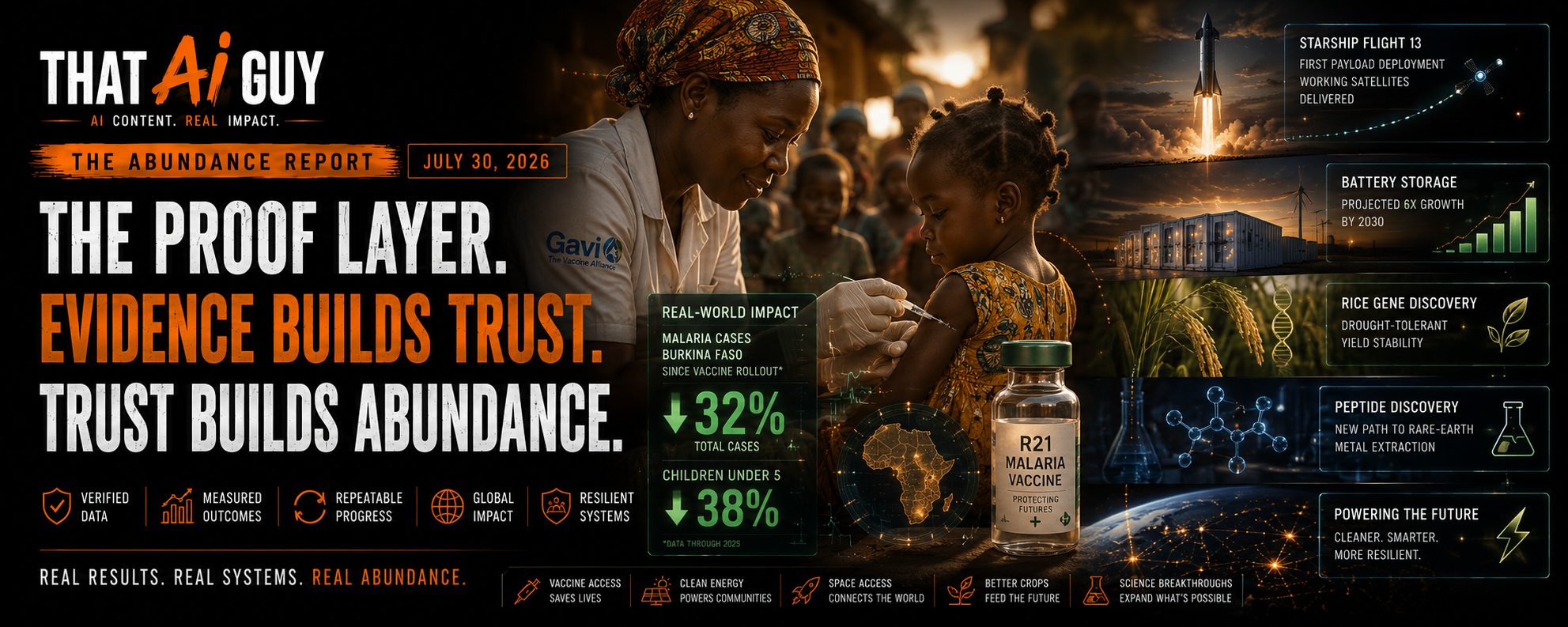
The most important abundance story this week is not one development. It is two that belong together: Gavi confirmed it is unlocking $600 million in U.S. funding for global immunization, and separately, new real-world data showed exactly what that kind of money buys. Malaria vaccines are now running in 25 African countries, and Burkina Faso, one of the earliest adopters, has recorded a 32% drop in total malaria cases since rollout.
That is not a model. That is not a trial endpoint. That is a measured decline in a disease that kills half a million people a year, most of them children.
The rest of the week filled in around that story. A reusable rocket delivered its first working satellites instead of just landing in one piece. Battery storage kept compounding toward a sixfold increase by 2030, backed by real first-half deployment numbers, not just a forecast. A rice gene gave plant breeders something specific to select for instead of a vague trait. And in the lab, two separate teams pushed at the edges of basic chemistry and physics, with no product to show yet, but with real findings published in real journals.
None of this is abundance in the utopian sense. Malaria is not solved. The rocket has flown once. The rice gene is a decade from a farmer’s field. But the throughline is consistent with what this newsletter keeps finding: the systems that keep people alive and connected are getting slightly less fragile, one verified data point at a time.
Breakthrough of the Week
Malaria Vaccines Are Now Showing Their Work
What happened: As of mid-2026, 25 African countries are implementing malaria vaccines, RTS,S and R21, including nine of the ten highest-burden countries. Doses distributed rose 169% year-over-year in 2025, to 28.3 million. Reporting published July 26, 2026 compiled the first real multi-year case data: Burkina Faso recorded a 32% drop in total malaria cases and a 38% decline in cases among children under five since introducing the vaccine. Cameroon documented a 17% reduction in confirmed cases over the same period.
Why it matters: A vaccine that works in a trial is a promising number. A vaccine that measurably reduces disease burden across a real health system, years into rollout, is a different kind of evidence. This is the second category.
What friction it removes: Malaria has always been a tax on everything else a family or a health system tries to do: missed school, missed work, overwhelmed clinics, preventable death. Fewer cases means fewer of those downstream costs, compounding year over year.
What to keep sober: Coverage drops off badly across the four-dose course, from about 80% for the first dose to 46% for the fourth. Real-world efficacy is running below what the trials showed, and emerging resistance in both parasites and mosquitoes is a live threat to these gains.
The abundance signal: This is not a headline cure. It is proof that a public health intervention can be deployed at continental scale and still show up in the numbers years later. That is the harder, more important test.
Source: MedicalXpress, July 26, 2026, WHO
Major Developments
1. Vaccine Funding Gets Unstuck
On July 30, 2026, Gavi, the Vaccine Alliance, announced that the U.S. government intends to release $600 million already appropriated by Congress for fiscal years 2025 and 2026. The money had been sitting stalled; this closes a real gap in vaccine access for low-income countries.
Why it matters: Gavi immunizes roughly half the world’s children. A funding gap does not show up as an abstract budget line. It shows up as doses that do not ship and clinics that run short.
What to keep sober: An “unlock” is an announcement, not a disbursement. Appropriated funds have been delayed before, and $600 million is a fraction of Gavi’s multi-billion-dollar five-year need.
The abundance signal: Money that was supposed to move finally moving is not glamorous. It is also exactly what keeps programs like the malaria vaccine rollout above from stalling.
Source: Gavi, July 30, 2026
2. The Grid Learns to Store What It Makes
New industry analysis published July 27, 2026 projects global battery storage capacity will grow sixfold by 2030. That forecast sits on top of real numbers: solar and storage supplied 91% of all new U.S. grid capacity in Q1 2026, the highest quarterly share ever recorded, and California’s battery fleet discharged a record 12.99 GW on July 9, enough to cover 36% of regional demand at peak.
Why it matters: Storage is the piece that turns intermittent solar and wind into power you can actually rely on at 7pm. Without it, clean generation caps out at whatever the sun and wind happen to be doing.
What to keep sober: A sixfold projection is a forecast. It depends on policy support, mineral supply chains, and interconnection speed, all of which have stalled build-outs before.
The abundance signal: The Q1 2026 numbers are not a projection. They are what already got built. The forecast is just extending a curve that is, for now, real.
Source: pv magazine USA, July 27, 2026
3. A Reusable Rocket Starts Delivering, Not Just Landing
On July 24, 2026, SpaceX’s Starship Flight 13 landed both its booster and upper stage and, for the first time, deployed working payloads: the first batch of operational Starlink V3 satellites.
Why it matters: Landing a rocket is a milestone. Landing a rocket that also did its job is the milestone that actually lowers the cost of getting things into orbit, including the satellites that carry broadband to places fiber will never reach.
What to keep sober: One successful flight is not a reliable, repeatable system. Starship’s real cost and reuse advantages still have to survive dozens more flights before they mean anything for pricing.
The abundance signal: Space access has been getting cheaper for over a decade. This is one more data point in that direction, not a new trend by itself.
Source: Spaceflight coverage, July 25, 2026
4. Rice Breeders Get a Genetic Target for Drought
Research covered July 29, 2026 identifies a mutation in the rice gene OsRRK1 that modifies an enzyme controlling sugar production during drought stress, directly linking plant metabolism to drought survival.
Why it matters: Rice feeds more than half the planet. A specific genetic mechanism is something breeders can actually select for. A vague “drought tolerant” trait is much harder to work with.
What to keep sober: This is a laboratory finding, not a released variety. Most discoveries like this take a decade or more to reach a commercial cultivar, if they get there at all.
The abundance signal: Food security under climate stress is not going to be solved by one gene. It is going to be solved by hundreds of findings like this one, quietly stacking up in breeding programs nobody outside the field is watching.
Source: ISAAA Crop Biotech Update, July 29, 2026
5. Basic Science Quietly Expands the Toolkit
Two unrelated findings this week fall into the same bucket: real, peer-reviewed, and years from mattering to anyone outside a lab. Rice University chemists, publishing in the Journal of the American Chemical Society, used a custom “molecular basket” to make the rare-earth metal neodymium form a previously unlikely bond with oxygen, opening a possible new class of reactive compounds. Separately, researchers reported July 28, 2026 that they built a device using laser light alone to steer electrons through a semiconductor, without an applied electric field.
Why it matters: Rare-earth chemistry underpins magnets and industrial catalysts. Electron control without an electric field is the kind of effect future chip and photonic designs get built on. Neither is useful yet. Both are the raw material future usefulness comes from.
What to keep sober: Foundational science regularly fails to translate into products. There is no identified application for either finding today.
The abundance signal: Most weeks, the science section of this newsletter is exactly this: nothing you can buy, nothing you can use, and the actual seed corn of everything that eventually is.
Source: Rice University News, ScienceDaily, July 28, 2026
6. Drug Discovery Gets a Free, Open Tool
Penn Engineering researchers published PeptiVerse in Nature Communications, reported the week of July 21, 2026: an open-source AI platform that predicts a peptide’s solubility, cell penetration, toxicity, stability, and protein binding before it is ever synthesized, through a public web interface.
Why it matters: Peptide drugs, including the GLP-1 class, are one of the fastest-growing categories of medicine. Testing candidates is slow and expensive. A free tool that screens out bad candidates before synthesis lowers that cost for any lab, not just the ones that can afford proprietary versions.
What to keep sober: Predictions still need experimental validation. Accuracy on genuinely novel peptides, outside the training data, is unproven at scale.
The abundance signal: This is the same pattern as Issue 6’s discovery-cost story: when the cost of testing a hypothesis drops, more hypotheses get tested, including by people who could never have afforded to before.
Source: Penn Engineering
Why This Matters
The connecting thread this week is not any single technology. It is that the most important stories were the least dramatic ones.
A vaccine program showed multi-year results instead of a trial press release. A funding gap closed instead of a new initiative launching. A grid added storage instead of promising a breakthrough battery chemistry. A rocket delivered cargo instead of just sticking the landing.
That is usually what real progress looks like: not a discovery becoming a miracle, but a system that already works becoming slightly more reliable, slightly cheaper, or slightly harder to defund.
The caution is the same as every week. None of this removes the need for institutions. Vaccine funding still has to actually disburse. Dose completion still has to improve past 46%. Storage still needs interconnection and permitting to keep pace. Starship still needs to fly again, and again, without incident. The rice gene still needs a decade in a breeding program. The invention and the institution have to improve together, or the invention stalls.
Abundance Index Score
This week’s score: 79/100
Last week: 78/100
Change: +1
Why the score rose: This week had something Issue 6 did not: hard, multi-year, real-world outcome data, in the malaria vaccine numbers, rather than early-stage or projected results. Measured lives saved outweighs a promising hit molecule.
Why the score is not higher: Most of this week’s stories are still infrastructure and access, not solved problems. Dose completion is dropping off badly in the malaria rollout. The Gavi funding is an announced unlock, not a disbursement. The battery storage figure is a forecast built on one strong quarter. The rice gene, the chemistry, and the physics findings are all years from mattering outside a lab.
Score interpretation: 79 means meaningful, evidenced progress with at least one real-world outcome behind it, but not broad transformation. Consistent with where this newsletter has sat for the last several weeks.
Looking Ahead
Does fourth-dose malaria vaccine coverage improve, or does the 80% to 46% drop-off become the story instead of the case-count decline?
Does Gavi’s $600 million actually disburse on the timeline announced, or does it join the list of appropriated funds that stall?
Does Starship fly again cleanly, or was Flight 13 a good day inside a still-inconsistent program?
Does the battery storage sixfold forecast survive contact with permitting queues and mineral supply constraints?
Does the OsRRK1 finding make it into an actual breeding program, or quietly disappear the way most single-gene discoveries do?
Closing Reflection
A funding gap closes.
A vaccine shows its work, years after the trial ended.
A rocket delivers cargo instead of just landing.
A grid gets a little harder to knock over.
A rice gene gives a breeder something to aim at.
None of it fixes anything by itself.
But each one is a little less friction between the systems that keep people alive and the people who depend on them.
That is the version of progress worth tracking: not everything solved, but fewer things stuck.
Source Notes and Fact-Check
Gavi $600 million funding unlock: verified as current, Gavi press release, July 30, 2026.
Malaria vaccine multi-country data and Burkina Faso case decline: verified, MedicalXpress, July 26, 2026, corroborated by WHO evidence summary.
Starship Flight 13 landing and Starlink V3 deployment: verified, spaceflight trade coverage, July 25, 2026.
Battery storage sixfold-by-2030 projection and Q1 2026 grid capacity share: verified, pv magazine USA, July 27, 2026, built on SEIA and CAISO first-half 2026 reporting.
OsRRK1 rice drought-tolerance gene: verified, ISAAA Crop Biotech Update, July 29, 2026, sourced to Plant Physiology.
Neodymium-oxygen chemistry: verified, Rice University News, July 24, 2026, published in the Journal of the American Chemical Society.
Electron-lighthouse semiconductor finding: verified, ScienceDaily, July 28, 2026.
PeptiVerse open-source peptide platform: verified, Penn Engineering, reporting dated the week of July 21, 2026, slightly outside the strict seven-day window and included as the most current AI-for-science development available.