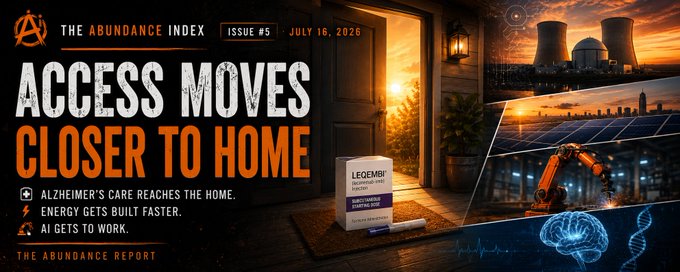
This week’s strongest progress was a practical access improvement in Alzheimer’s care, surrounded by a wider pattern of capability moving downstream.
Date: July 16, 2026
Overall Abundance Score: 77/100
Status: Better than last week, but still measured. The strongest progress this week was not a moonshot announcement. It was a practical access improvement in Alzheimer’s treatment, backed by a wider pattern: medicine, energy, robotics, and resilience systems are moving from abstract capability toward usable infrastructure.
Executive Summary
This week’s most important abundance story was the FDA’s July 13 approval of a new starting-dose regimen for the subcutaneous formulation of Leqembi, allowing eligible Alzheimer’s patients to begin treatment through home administration by the patient or a caregiver.
That does not make Alzheimer’s solved. Leqembi is for a specific early-stage population, requires amyloid confirmation, carries serious safety risks, and still depends on medical oversight. But it does remove a real access bottleneck. A treatment that previously began through clinic-based IV infusion can now, for appropriate patients, start closer to ordinary life.
The broader theme this week is capability moving downstream. Nuclear policy is trying to shorten the path from design to deployment. Solar and storage are already adding capacity faster than most older grid narratives expected. Physical AI is moving from demos toward serious industrial partnerships. Precision oncology continues to show why genetic targeting matters, even when the relevant approval is not new this week. And disaster-risk finance is becoming more precise about getting money to governments after shocks.
The honest conclusion: humanity did not become dramatically abundant this week. But several systems became slightly less constrained. Healthcare access got less clinic-bound. Energy planning became more serious about firm power and rapid deployment. Robotics moved closer to labor-shortage use cases. Climate and disaster finance kept shifting from after-the-fact appeals toward pre-arranged resilience.
That is what progress often looks like when it is real: less friction between invention and use.
Breakthrough of the Week
Alzheimer’s Treatment Took a Step Toward the Home
What happened: On July 13, 2026, the FDA approved a new starting dosage regimen for the subcutaneous formulation of Leqembi (lecanemab-irmb), an amyloid beta-directed antibody for adult patients with Alzheimer’s disease.
Previously, FDA materials describe the starting regimen as intravenous, with the option to transition to IV or subcutaneous maintenance after 18 months. The new approval is notable because patients can begin treatment with home administration by themselves or a caregiver.
Why it matters: Medicine does not become abundant only when a new molecule is invented. It becomes abundant when proven interventions are easier to access, easier to schedule, and less dependent on specialized locations.
For families dealing with early Alzheimer’s disease, repeated clinic visits are not a small inconvenience. They are transportation, caregiving time, scheduling, emotional load, and cost. Moving part of the treatment burden into the home does not remove the disease, but it does reduce the amount of life that has to orbit around the clinic.
What friction it removes: The bottleneck here is delivery. A therapy that requires regular infusion-center visits has a smaller practical reach than one that can be administered at home under the right medical conditions. That matters especially for patients who live far from specialty centers or rely on family caregivers.
What to keep sober: The subcutaneous starting formulation was not tested separately in large clinical outcome trials. The FDA says its support comes from the already demonstrated effectiveness of the IV formulation and evidence that the subcutaneous formulation produced equivalent exposure in the body and similar amyloid-plaque reductions.
Safety also matters. FDA materials highlight amyloid-related imaging abnormalities, including brain swelling and bleeding risks, and state that ApoE e4 testing should be performed before starting treatment to inform ARIA risk.
The abundance signal: This is not a cure. It is not a broad dementia solution. It is a narrow but meaningful access improvement for a difficult disease.
And that counts.
Source: FDA, July 13, 2026. https://www.fda.gov/drugs/news-events-human-drugs/fda-approves-first-home-starting-dose-alzheimers-disease-treatment
Major Developments
1. Energy Progress Is Splitting Into Two Useful Tracks
The energy story is not “nuclear versus renewables.” That frame is too small.
The more useful frame is speed plus firmness.
Solar and batteries are the speed layer. EIA’s latest capacity reporting showed developers added 12 GW of U.S. utility-scale solar in the first half of 2025 and planned another 21 GW in the second half. If realized, solar would account for more than half of 64 GW of planned U.S. generating-capacity additions for 2025. Battery storage was the second-largest source of additions in the first half, and Texas was a major driver for both solar and storage.
Nuclear is the firmness layer. DOE’s May 2026 nuclear update reported several concrete milestones: TerraPower’s Natrium project received the first NRC construction permit ever issued for a commercial non-light-water power reactor, DOE’s reactor pilot program aimed for at least three advanced designs to reach criticality by July 4, 2026, and DOE is using the Genesis Mission framework to apply AI to reactor design, licensing, manufacturing, construction, operations, fuel supply, and waste.
Why it matters: AI data centers, electrified industry, desalination, battery factories, synthetic fuels, advanced manufacturing, and climate adaptation all need electricity. Cheap intermittent generation helps. Firm clean power helps. Storage helps. Transmission helps. The abundance story is not one technology winning. It is the grid gaining more ways to supply power under different constraints.
What friction it removes: Solar and storage reduce deployment time. Advanced nuclear, if it can prove cost and licensing repeatability, could reduce the firm-power constraint. AI-assisted nuclear workflows might reduce engineering and regulatory complexity, but that claim still has to survive contact with real projects.
What to keep sober: DOE’s nuclear update is policy-forward and optimistic. Nuclear projects still face fuel-supply limits, construction risk, public trust issues, waste questions, and first-of-a-kind cost overruns. Solar and batteries face interconnection queues, transmission bottlenecks, curtailment, local permitting, and supply-chain questions.
The abundance signal: Energy abundance is not arriving as one miracle. It is arriving as a portfolio: faster solar, more storage, revived nuclear options, and more pressure to make the grid less fragile.
Sources: DOE, May 23, 2026. DOE nuclear update. EIA, August 20, 2025. EIA capacity report.
2. Physical AI Moved Into a Serious Industrial Coalition
On July 16, AP reported that Fujitsu, Nvidia, Fanuc, Yaskawa Electric, and Kawasaki Heavy Industries announced a Japanese physical-AI initiative in Tokyo.
The goal is not just chatbots in factories. It is AI embedded in machines that can work safely around people in factories, homes, and hospitals. The companies framed the effort partly around Japan’s labor shortage and aging population.
Why it matters: Human abundance depends on the physical world getting easier to build, inspect, move, repair, and care for. Software alone cannot weld a structure, move a patient, stock a warehouse, inspect a machine, or help an older person in a home.
Physical AI matters because it tries to attach intelligence to action.
What friction it removes: Factories and care systems face labor constraints, safety risks, repetitive tasks, and rising demand. Better robotics can reduce the human cost of dangerous, dull, or physically punishing work while increasing output.
What to keep sober: The companies did not provide a firm timeline for robots arriving in daily life. The first phase of collaboration is expected later this year, and there is no announced joint venture. Robotics is hard because the physical world is variable, safety-critical, and expensive to test.
The abundance signal: The useful question is not whether robots replace people tomorrow. The useful question is whether machines can take more of the dangerous and repetitive load while people supervise, maintain, design, and use the systems.
If that happens, productivity rises without requiring everyone to work harder.
Source: Associated Press, July 16, 2026. https://apnews.com/article/ai-nvidia-fujitsu-japan-technology-robots-tokyo-86823c1bcc959ad603ecb25d022207b1
3. Precision Medicine Kept Improving the Fit Between Disease and Treatment
The rough draft used HERNEXEOS as a fresh example. That claim needed correction: HERNEXEOS was approved on August 8, 2025, not this week.
It is still a useful signal.
FDA’s Drug Trials Snapshot reports that HERNEXEOS (zongertinib) was approved for adults with unresectable or metastatic non-squamous non-small cell lung cancer whose tumors have HER2 tyrosine kinase domain activating mutations, after prior systemic therapy. In the Beamion LUNG-1 trial, 75% of 71 patients without prior HER2-targeted ADC treatment had complete or partial tumor shrinkage, and 58% had responses lasting at least six months.
Why it matters: This is the direction medicine keeps moving: smaller patient groups, clearer molecular targets, and treatments matched to the driver of disease rather than the organ label alone.
What friction it removes: Precision oncology reduces one of medicine’s oldest inefficiencies: treating biologically different diseases as if they are the same because they appear in the same tissue. Better matching can mean better response rates for the patients whose tumors actually carry the target.
What to keep sober: This was an accelerated approval, not a final proof of long-term survival benefit. The FDA notes serious risks including liver, lung, and heart problems. Also, the relevant patient population is narrow.
The abundance signal: Precision medicine expands abundance by reducing wasted treatment. It makes the system more intelligent about who is likely to benefit.
Source: FDA, HERNEXEOS Drug Trials Snapshot. https://www.fda.gov/drugs/drug-trials-snapshots/drug-trials-snapshots-hernexeos
4. Disaster Finance Is Becoming More Pre-Arranged and Human-Centered
The draft’s Lao PDR and Kenya examples were useful, but they were not this week’s developments. They belong in the report as context, not as breaking news.
World Bank materials describe Lao PDR’s May 2025 sovereign disaster risk insurance policy as one of the first with a people-affected impact trigger. The policy had a two-year $3.4 million premium, up to $16 million in coverage, and delivered a $2 million payout within six business days after disasters affected more than 300,000 people.
The same World Bank overview describes Kenya’s Jobs and Economic Transformation Project, which began in December 2023 and includes green SME financing through a Green Investment Fund intended to mobilize private capital for small and medium-sized businesses adopting green technologies.
Why it matters: Abundance is not only the ceiling of capability. It is also the floor under people when systems break.
Disasters become more damaging when money arrives late. Small businesses adopt cleaner or more efficient tools more slowly when capital is expensive or unavailable. Better financial plumbing can keep temporary shocks from becoming permanent losses.
What friction it removes: Impact-triggered insurance shortens the time between disaster and liquidity. Green SME financing lowers the capital barrier for small firms that cannot fund upgrades out of cash flow.
What to keep sober: Insurance is not prevention. It does not rebuild homes by itself, and it does not solve governance, logistics, corruption, or reconstruction capacity. Green funds also have to prove that they reach useful projects rather than just producing nice financing language.
The abundance signal: Resilience improves when recovery is planned before the disaster. That is less dramatic than a rescue mission, but it is often more effective.
Source: World Bank Group, Financial Inclusion overview. https://www.worldbank.org/ext/en/topic/financial-sector/financial-inclusion
Why This Matters
The connecting thread this week is not acceleration for its own sake.
It is translation.
Alzheimer’s treatment translated from clinic-first infusion into a home-start option for eligible patients.
Energy planning translated from climate aspiration into capacity additions, construction permits, fuel programs, and AI-assisted workflows.
Physical AI translated from keynote language into a coalition of companies that actually make industrial robots.
Precision oncology translated genetic information into a narrower, more targeted treatment path.
Disaster finance translated abstract resilience into pre-arranged money that can arrive within business days.
That is the actual work of abundance: not merely inventing new capability, but reducing the friction between capability and use.
The caution is equally important. None of these developments removes the need for institutions. In fact, they make institutions matter more.
Home Alzheimer’s treatment still needs diagnosis, monitoring, imaging, risk screening, and caregiver education.
Nuclear still needs regulators, fuel supply, safety culture, construction discipline, and public trust.
Robotics still needs standards, worker training, liability rules, and real-world reliability.
Precision medicine still needs genetic testing, clinical evidence, payer access, and post-approval confirmation.
Disaster insurance still needs honest data, fast distribution, and competent recovery systems.
The future gets better when the invention and the institution improve together.
Abundance Index Score
This week’s score: 77/100
Last week: 74/100
Change: +3
Why the score rose: Last week’s report was mostly about enabling progress: maintenance tools, pilots, curriculum, fraud monitoring, and test-reactor milestones. This week includes a more direct human-access improvement with the FDA’s Leqembi home-start approval, plus a current industrial robotics coalition and continued evidence that energy systems are diversifying.
Why the score is not higher: Most of the week is still infrastructure and access, not solved outcomes. Alzheimer’s remains devastating. Leqembi is narrow and risk-managed. Nuclear economics remain unproven at scale. Physical AI is still early. Precision oncology examples remain highly specific. Disaster finance helps recovery, but does not prevent the disaster.
Score interpretation: 77 means meaningful progress with real-world relevance, but not broad transformation yet.
The score feels earned because the week did contain a concrete access breakthrough. It stays below 80 because implementation risk is still the dominant story.
Looking Ahead
The next questions are practical:
Can home-start Alzheimer’s treatment be delivered safely and equitably outside major medical centers?
Will solar and storage additions continue to outpace grid bottlenecks, or will interconnection and transmission slow the curve?
Can advanced nuclear projects prove construction repeatability rather than just regulatory momentum?
Will physical AI move from partnership announcements into measured productivity and safety gains?
Will precision oncology approvals translate into broader testing access, so eligible patients are actually found?
Will disaster-risk payouts reach affected people quickly enough to change recovery outcomes?
The pattern to watch is not the announcement.
It is the second step after the announcement.
Closing Reflection
The best abundance stories are often humble.
A drug regimen becomes easier to start.
A grid adds more clean capacity.
A reactor design gets closer to construction.
A robot partnership forms around real labor shortages.
A cancer treatment fits a tumor mutation more precisely.
An insurance payout arrives in days instead of months.
None of this makes scarcity disappear.
But each step removes a little friction from human life.
That is the version of progress worth taking seriously:
not everything fixed, but more things becoming possible, closer to where people actually live.
Source Notes and Fact-Check
FDA Leqembi home-start approval: verified as current July 13, 2026.
DOE nuclear renaissance update: verified, but dated May 23, 2026. Used as current-year energy context, not as a July 16 breaking development.
EIA solar and storage capacity article: verified, but dated August 20, 2025. Used as the latest cited EIA capacity context from the rough draft, not as this week’s event.
HERNEXEOS: verified FDA approval date is August 8, 2025, not this week. Kept only as precision-medicine context and clearly labeled.
World Bank Lao PDR/Kenya examples: verified, but not this week. Kept only as resilience context and clearly labeled.
Physical AI Japan coalition: verified as July 16, 2026 reporting from AP.