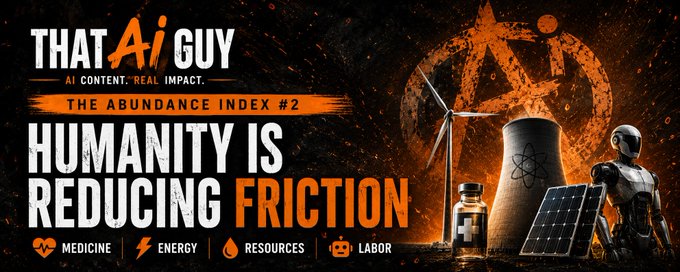
Friction in medicine.
Friction in energy.
Friction in labor.
Friction in resources.
For most of human history, progress meant finding ways to reduce those frictions one problem at a time.
This week, humanity reduced all four.
Not through promises.
Through deployment.
The Wrong Way to Think About Progress
Most people evaluate the future through headlines.
A recession here.
A conflict there.
A company misses earnings.
A politician says something outrageous.
The result is a constant feeling that everything is getting worse.
But civilization doesn’t move at the speed of headlines.
It moves at the speed of infrastructure.
At the speed of scientific discovery.
At the speed of systems becoming more capable.
The question isn’t:
“What went wrong this week?”
The question is:
“What became easier?”
This week, quite a lot became easier.
Medical Friction Is Falling
For decades, one of the most promising cancer treatments has been CAR-T therapy.
The concept is remarkable.
Take a patient’s immune cells.
Modify them.
Turn them into cancer hunters.
Return them to the body.
The problem is that the process is expensive, complex, and difficult to scale.
Now researchers are moving toward in vivo CAR-T therapies, where the modification happens directly inside the patient.
The factory is no longer the laboratory.
The factory becomes the human body.
That shift has the potential to dramatically lower costs while expanding access to life-saving treatment.
Elsewhere, researchers continue making progress against diseases that were once considered untouchable.
Quantum-powered drug discovery is helping scientists target proteins previously considered “undruggable.”
Stem-cell therapies for Parkinson’s disease continue advancing through clinical trials.
New approaches to pediatric brain cancers are extending survival from months to years.
The story is larger than any individual breakthrough.
Medicine is becoming more precise.
More personalized.
More scalable.
The friction between diagnosis and treatment is shrinking.
Energy Friction Is Falling
Every discussion about the future eventually runs into the same question:
Where will the energy come from?
Artificial intelligence.
Robotics.
Manufacturing.
Desalination.
Electrified transportation.
All of it requires power.
Lots of it.
This week brought evidence that humanity is pursuing a dual-track strategy.
On one side is nuclear energy.
The United States continues efforts to expand reactor output, restart dormant facilities, and build the foundation for a significant increase in nuclear generation capacity over the coming decades.
On the other side is renewable energy.
Globally, the wind and utility-scale solar development pipeline has reached nearly 5 terawatts.
Five terawatts.
That is not a pilot project.
That is civilization-scale infrastructure.
The challenge is no longer whether we can generate power.
Increasingly, the challenge is how quickly we can move it where it’s needed.
That is a very different problem than the energy shortages that defined previous generations.
Resource Friction Is Falling
Water remains one of the most important constraints on human prosperity.
Cities need it.
Agriculture needs it.
Industry needs it.
People need it.
This week saw major investments in both western water infrastructure and urban water modernization.
These projects are not flashy.
Nobody builds a movie around a canal upgrade.
Yet these systems quietly determine whether millions of people can thrive.
Infrastructure rarely gets celebrated.
Until it fails.
The reality is that abundance begins with reliable systems.
Clean water.
Reliable electricity.
Accessible healthcare.
The foundations matter.
And this week, humanity invested heavily in strengthening those foundations.
Labor Friction Is Falling
Perhaps the most significant long-term story is happening in robotics.
For years, people have talked about humanoid robots as if they were science fiction.
Now they are becoming industrial products.
China is rapidly scaling production.
Hardware costs continue falling.
Capabilities continue improving.
Most importantly, artificial intelligence is increasingly giving these machines useful skills.
The first industrial revolution amplified muscle.
The digital revolution amplified information.
The AI revolution is beginning to amplify labor itself.
Not by replacing every worker overnight.
By reducing the cost of physical work.
The same way computers reduced the cost of computation.
The implications are enormous.
When labor becomes cheaper, the cost of everything built by labor begins to fall.
That is one of the most powerful engines of abundance ever discovered.
The Bigger Pattern
These developments may seem unrelated.
Cancer therapies.
Nuclear reactors.
Water systems.
Humanoid robots.
But they are all expressions of the same trend.
Humanity is reducing friction.
Medical friction.
Energy friction.
Resource friction.
Labor friction.
The history of civilization is the history of removing bottlenecks.
The steam engine reduced transportation bottlenecks.
Electricity reduced industrial bottlenecks.
Computers reduced information bottlenecks.
Artificial intelligence is helping reduce cognitive bottlenecks.
Now we are seeing breakthroughs across multiple domains simultaneously.
That matters.
Because abundance is not created by a single invention.
It emerges when enough bottlenecks disappear at the same time.
What Got Better This Week?
Millions of rural Americans moved one step closer to modern healthcare.
Cancer treatments became easier to manufacture and potentially cheaper to deliver.
The global energy pipeline expanded.
Water infrastructure became more resilient.
Humanoid robots became more affordable and more capable.
None of these developments will change the world tomorrow morning.
But civilization rarely changes in a single day.
It changes through thousands of incremental improvements that compound over time.
And this week delivered several of them.
The future does not arrive all at once.
It arrives as friction slowly disappears.
Daily Abundance Index: 82/100
A strong week for humanity.
Not because everything is solved.
Because measurable progress continues across the systems that keep civilization running.
The arc of progress is rarely obvious when you’re standing inside it.
But if you step back and look carefully, the pattern becomes clear.
Humanity is getting better at being human.