
September 10, 2026
Overall Abundance Score: 73/100
Status: Down four points from last week’s 77. Last week had one complete win sitting next to four early ones. This week has zero complete wins. Five real stories, and every one of them is still on trial.
Executive Summary
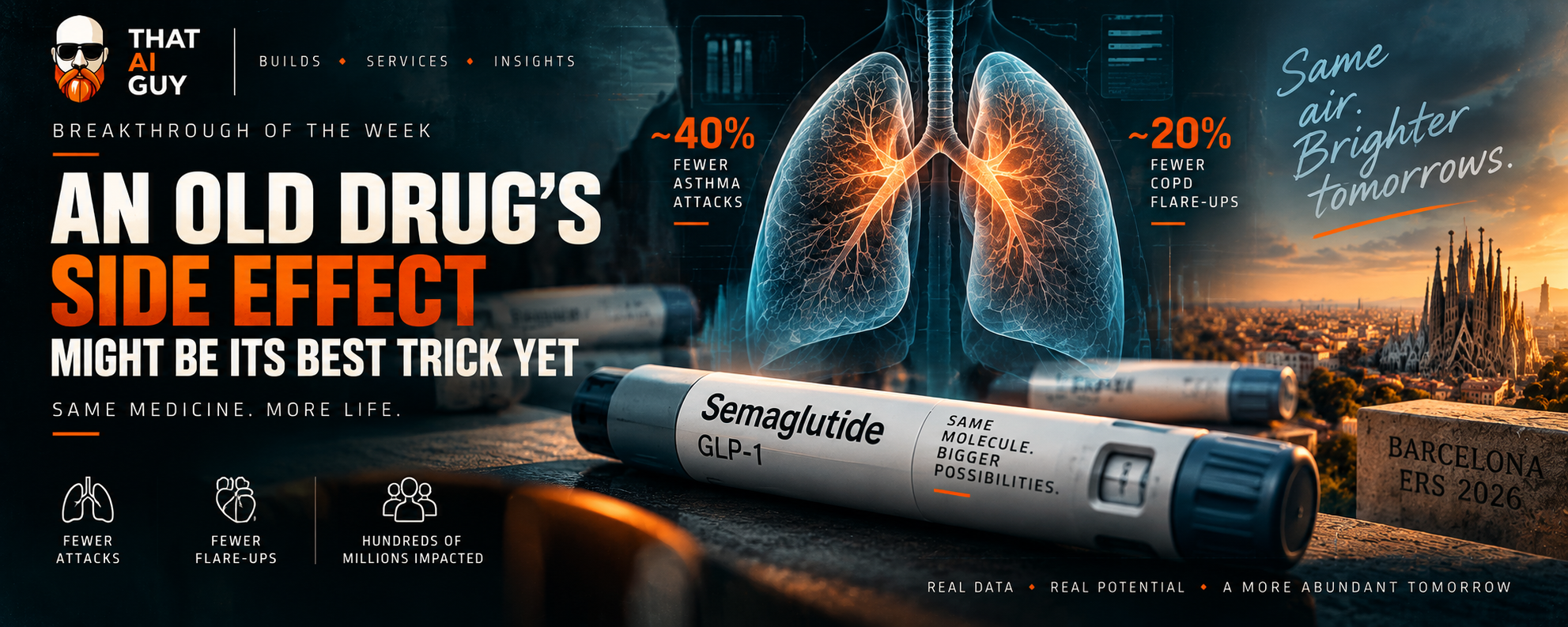
Start with the one that could matter to the most people, if it survives contact with an actual clinical trial. At the European Respiratory Society Congress in Barcelona on September 9, researchers reported that semaglutide, the drug in Ozempic and Wegovy, was linked to nearly 40% fewer asthma attacks and about 20% fewer COPD flare-ups. Nobody invented anything to get this result. Tens of millions of people already take GLP-1 drugs for diabetes and weight loss, and some of them might be getting a second benefit nobody prescribed them for. That’s a nice reminder of how abundance often actually shows up: not as a new pill, but as an old one turning out to be worth more than the label says.
Everything else this week is a smaller version of the same story. A German lab found a receptor, GPR133, that builds stronger bones in mice when switched on with an experimental compound. Five European countries set new September solar records in the same week, using panels that were already bolted down before Monday. Rolls-Royce SMR and ABB agreed to explore working together on the automation guts of a reactor design that already has customers lined up in the UK, Czechia, and Sweden. And Corteva’s ag spinoff, Vylor, unveiled a corn trait worth an extra three bushels an acre, squeezed out of a crop we’ve been breeding since before written history. Different industries, same move. Nobody’s introducing anything from scratch. Everybody’s asking more of something that already exists.
And yes, there’s a catch on every single one. The semaglutide data is observational, not a randomized trial, and it doesn’t even hold across the drug class: three other GLP-1s tested alongside it showed nothing. The researcher who ran the study said as much herself, that this shouldn’t change anyone’s treatment yet. The bone compound has never touched a human. The Rolls-Royce/ABB deal is a memorandum of understanding, corporate for “let’s sort out the details later.” And Europe’s solar records came with a bill attached: wholesale power prices in Italy, Spain, and Portugal hit multi-year highs the same week, because low wind and a natural-gas spike more than ate the extra sunlight. More solar didn’t mean cheaper power. Not this week, anyway.
So...a real week, an interesting one, but not one where anything actually finished. Worth remembering that most weeks look like this one. The week a fatal disease gets its first-ever drug is the exception, not the rule.
Breakthrough of the Week
An old drug’s side effect might be its best trick yet
What happened: At the ERS Congress in Barcelona on September 9, Professor Chloe Bloom of Imperial College London and colleagues ran four parallel studies, 20,000 to 22,000 people each, off UK medical records. People with asthma or COPD who started a GLP-1 drug had fewer attacks than similar patients started on a different diabetes medication, a sulfonylurea. Semaglutide stood out: nearly 40% fewer asthma attacks, 20% fewer COPD flare-ups.
Why it matters: Asthma and COPD affect hundreds of millions of people, and GLP-1 drugs are already among the most prescribed medications on Earth. If this holds up, a drug already sitting in tens of millions of medicine cabinets might be protecting some of those same lungs, for free, with no new manufacturing and no new approval process required.
What friction it removes: A new respiratory drug normally means a decade of trials and a prescription most patients don’t have yet. This would mean a benefit riding shotgun on a prescription they already do.
What to keep sober: This is real-world data, not a randomized trial, and Dr. Bloom was blunt about it: “these findings should not change treatment decisions on their own,” and nobody should start a GLP-1 drug just to treat their asthma. The bigger problem is that liraglutide, dulaglutide, and exenatide, the other GLP-1s in the study, didn’t show the same protection. That’s the kind of detail that should make you suspicious it’s a semaglutide quirk rather than a class effect. Confirmatory trials haven’t started.
The abundance signal: Not a new molecule. An old one, worth more than anyone paid for it.
Source: ScienceDaily / European Respiratory Society, September 9, 2026
Major Developments
1. A receptor nobody had heard of might keep bones from breaking

Leipzig University researchers identified GPR133, a receptor on bone cells, as a switch that tips the balance toward building bone over breaking it down. Using an experimental compound called AP503, found through a computer screen, the team meaningfully increased bone strength in both healthy mice and mice with osteoporosis-like bone loss, including a model built to mimic what happens after menopause. The same pathway had already been tied, in earlier work from the same lab, to stronger muscle.
What to keep sober: Every result here is a mouse result. No human trial has been announced, and the researchers frame this as one target among several they’re still chasing. Osteoporosis affects roughly six million people in Germany alone, mostly women, and existing treatments have real limits, so a genuinely new mechanism is worth watching. It’s also, at minimum, years from anyone’s medicine cabinet.
The abundance signal: A disease with real treatment gaps just picked up a new target, one that might help muscle too, in exactly the population losing both at once.
Source: ScienceDaily / Universität Leipzig, September 9, 2026
2. Europe’s solar panels had a record week. So did its electricity bill

France, Germany, Italy, Portugal, and Spain all set new September solar-output records last week, per AleaSoft Energy Forecasting: Portugal hit 31 GWh on September 2, Spain hit 267 GWh on September 3, France and Italy broke records on September 4, and Germany capped it off with 389 GWh on September 6.
What to keep sober: The same week, wholesale power prices in Italy, Spain, and Portugal hit their highest levels since 2022 or early 2023. AleaSoft blames a drop in wind output, hot weather pushing up demand, and a gas-price spike tied to tension in the Strait of Hormuz choking off LNG from Qatar and the UAE. More solar didn’t mean cheaper electricity, because the grid still leaned on gas and wind to cover the gaps, and both of those had a bad week at the same time.
The abundance signal: Solar did exactly its job. The catch isn’t that solar failed. It’s that a grid is only as cheap as its least reliable piece on any given day, and that’s still usually gas or wind, not the sun.
Source: pv magazine, September 8, 2026
3. Nuclear’s assembly line just picked up a subcontractor

ABB and Rolls-Royce SMR signed a memorandum of understanding on September 8 to explore ABB supplying automation, electrification, and communications tech for Rolls-Royce’s small modular reactor fleet. The design is a 470 MWe pressurized water reactor, about 90% built in a factory before it ever reaches a site, and it’s already lined up for projects in the UK, Czechia, and Sweden.
What to keep sober: This is an agreement to talk, not a contract to build. The UK’s own final investment decision on its first unit isn’t due until 2029. The entire pitch for factory-built nuclear is that unit five is cheaper than unit one; nobody’s built five of these yet, so that’s still a claim, not a track record.
The abundance signal: Standardized nuclear only gets cheap if the supply chain around it standardizes too. Locking in an automation partner before construction starts is a small, unglamorous step in that direction.
Source: World Nuclear News, September 8, 2026
4. A seed company is betting $2 billion that three more bushels an acre matters

Ahead of its October 1 spinoff from Corteva, Vylor unveiled a corn roadmap running through 2035, headlined by what it calls the industry’s first trait built specifically for yield stability, not just yield. Field trials across the Americas showed an average gain of three bushels per acre, up to 10 in some trials. Vylor projects more than $2 billion in incremental revenue from the corn pipeline by 2035, licensing included.
What to keep sober: This is a press release ahead of a corporate spinoff, and three bushels an acre is a modest gain by the standards of past breeding milestones. The company’s own footnote says as much: everything here is “subject to completion of field testing and applicable regulatory reviews.” Most of the actual products don’t launch until 2028 or later. The announcement is also dated September 1, a touch outside this issue’s usual window, included here because it directly touches global food production and hadn’t run yet.
The abundance signal: Corn is one of the most-planted crops on the planet. A few extra bushels an acre, multiplied across millions of acres, is meaningfully more food from the same land, water, and fertilizer already going into the ground.
Source: Corteva, September 1, 2026
Why This Matters
The thread under all five stories: nothing this week got invented from nothing. A drug already prescribed to tens of millions turned out to do more than its label says. A receptor that’s been sitting in bone cells the whole time turned out to matter. Panels already bolted to rooftops set a record. A reactor design that already exists found a partner to help it scale. A crop we’ve bred for ten thousand years got a little better at its job. Abundance doesn’t always arrive with a press conference. Half the time it looks like squeezing more out of something you already built, planted, or approved.
The honest catch: squeezing more out of what you’ve got still has to be proven, not assumed. The semaglutide finding needs a randomized trial nobody’s started. The bone compound needs to clear mice before it can think about humans. The SMR deal needs an actual investment decision, still four years out. And Europe’s solar records are a decent reminder that progress on one input, sunlight capture, doesn’t automatically show up in the number people actually feel, their power bill, if the rest of the system hasn’t caught up yet.
Abundance Index Score

This week’s score: 73/100
Last week: 77/100
Change: -4
Why the score fell: Last week had one story that was completely, durably done: an FDA-approved drug, in hand, for a disease that had nothing. This week has no equivalent. Five promising stories, five stories still in progress: observational data waiting on a trial, a mouse study, a non-binding agreement, a multi-year roadmap, and a record week with a price hike attached. Wide, but nothing closed.
Why the score is not higher: None of it’s finished. The strongest story, semaglutide’s respiratory effect, is undercut by its own inconsistency across the drug class. The least proven is still living entirely in mouse cages. Call it a week where the ideas are ahead of the receipts.
Score interpretation: A low-70s score means real, verifiable movement across a wide range of fields, with nothing that’s crossed all the way from promising to proven.
Looking Ahead
Does semaglutide’s asthma and COPD benefit survive an actual randomized trial, or join the pile of real-world correlations that don’t?
Does anyone register a human trial for the AP503/GPR133 bone compound, the way MD Anderson did for last month’s psilocybin-neuropathy mouse result?
Do Europe’s record solar and record prices turn out to be a one-week fluke, or the new normal for weeks when sun, wind, and gas all misbehave together?
Does the Rolls-Royce SMR/ABB partnership become an actual supply contract before the UK’s 2029 investment decision, or stay a memorandum?
When Vylor’s first corn products actually launch in 2028, do the yield gains from real farmer fields match the ones from company trials?
Closing Reflection
Abundance isn’t only invention. Sometimes it’s just finally asking more of what you’d already got.
Source Notes and Fact-Check
Semaglutide (Ozempic/Wegovy) linked to a nearly 40% reduction in asthma attacks and 20% reduction in COPD flare-ups in a real-world UK electronic-medical-records study of four cohorts of 20,000–22,000 patients each, presented at the European Respiratory Society Congress: verified current,
ScienceDaily / European Respiratory Society, September 9, 2026
.
GPR133 receptor activation via the experimental compound AP503 significantly increasing bone strength in healthy and osteoporotic mice, from Leipzig University: verified current,
ScienceDaily / Universität Leipzig, September 9, 2026
.
France, Germany, Italy, Portugal, and Spain setting new September daily solar-output records between September 2–6, alongside multi-year-high wholesale electricity prices driven by low wind output and rising gas futures: verified current,
pv magazine, September 8, 2026
.
ABB and Rolls-Royce SMR signing a memorandum of understanding to explore automation and electrification collaboration on Rolls-Royce’s small modular reactor fleet: verified current,
World Nuclear News, September 8, 2026
.
Vylor (Corteva spinoff) unveiling a corn technology roadmap through 2035, including a first-of-its-kind yield-and-yield-stability trait delivering an average 3 bushels/acre gain in Americas field trials: falls slightly outside this issue’s seven-day window (announcement dated September 1) but included because of its direct relevance to global food production and because it had not appeared in a prior issue; verified current,
.